

Scan to download Babaoo Attention

.svg)


Everything you need to know about
Speech therapists



When should you see a speech therapist?
Speech therapy explained to parents
Signs I notice in my child
Certain signs I perceive in my child may lead me to discuss with my doctor the potential benefits of a speech therapy assessment:
- They have difficulty chewing, swallowing or eating certain foods.
- They struggle to clearly express their ideas or emotions.
- A teacher or a healthcare professional (such as a pediatrician) questions their communication or comprehension.
- They mispronounce certain sounds or words.
- They experience difficulties with reading, writing, or oral expression at school.
- Their language is developing more slowly than that of other children their age.
The role of the speech therapist
This healthcare professional specializes in the prevention, assessment, and treatment of communication, oral and written language, voice, speech, swallowing, and associated cognitive disorders. They particularly support children who have difficulty expressing themselves, understanding, reading, writing, or feeding, offering interventions tailored to each individual situation.
Goals of speech therapy sessions
Speech therapy sessions aim to:
- Raising awareness and supporting the family is essential to supporting the child's development. All studies show that understanding the challenges the child faces and having the support of their family and friends are key factors in the success of their care.
- Developing swallowing and feeding skills in cases of oromotor disorders.
- Develop and improve oral and written language skills, to facilitate communication and academic learning.
- Implement compensatory strategies to address certain persistent difficulties.
- Boosting the child's self-confidence by enabling them to better express themselves and interact with those around them.
🎯 Objective : To develop fragile or deficient skills while maintaining self-confidence and self-esteem.
Areas of intervention in speech therapy
Speech therapists work with children who have various special needs, such as:
- Feeding and Oral Disorders
– Sucking, Chewing, or Swallowing Difficulties
– Feeding Disorders in Infants or Young Children
– Food Refusal or Selectivity Related to Sensory or Motor Disorders - Oral language
– Articulation disorders (mispronunciations, omissions of sounds, etc.)
– Stuttering
– Limited vocabulary or difficulty accessing vocabulary
– Language delay
– Lack of fluency or clarity in oral expression
– Difficulty understanding or producing complex sentences
– Pragmatic disorders (social interaction, expression of emotions, non-verbal communication) - Written language
– Reading difficulties (dyslexia)
– Writing and spelling difficulties (dysorthography)
– Problems with sentence structure or reading comprehension
– Difficulty transitioning from oral to written language - Mathematical cognition
– Logical-mathematical reasoning disorder (dyscalculia)
– Difficulty understanding basic numerical concepts
– Problems with problem-solving or logical reasoning
– Impairment of calculation skills or spatial-temporal awareness
Missions of the speech therapist
Speech therapists work in several areas, including:
- Prevention and screening for communication and language disorders.
- The assessment of language, communication and oral-motor skills.
- Rehabilitation of identified disorders, through adapted exercises.
- Providing advice and support to families and teachers, to support the child in their daily environment.
- Close collaboration with other professionals who support the child (teacher, psychologist, occupational therapist, neuropsychologist) for a comprehensive and cross-cutting approach.
Methods and tools used by speech therapists
Speech therapists draw on various approaches. Best practice guidelines agree on the importance of Evidence-Based Practice, which relies on scientific evidence, the speech-language pathologist's clinical observations, and the patient's needs and preferences. To this end, the speech therapist uses:
- Cognitive remediation techniques
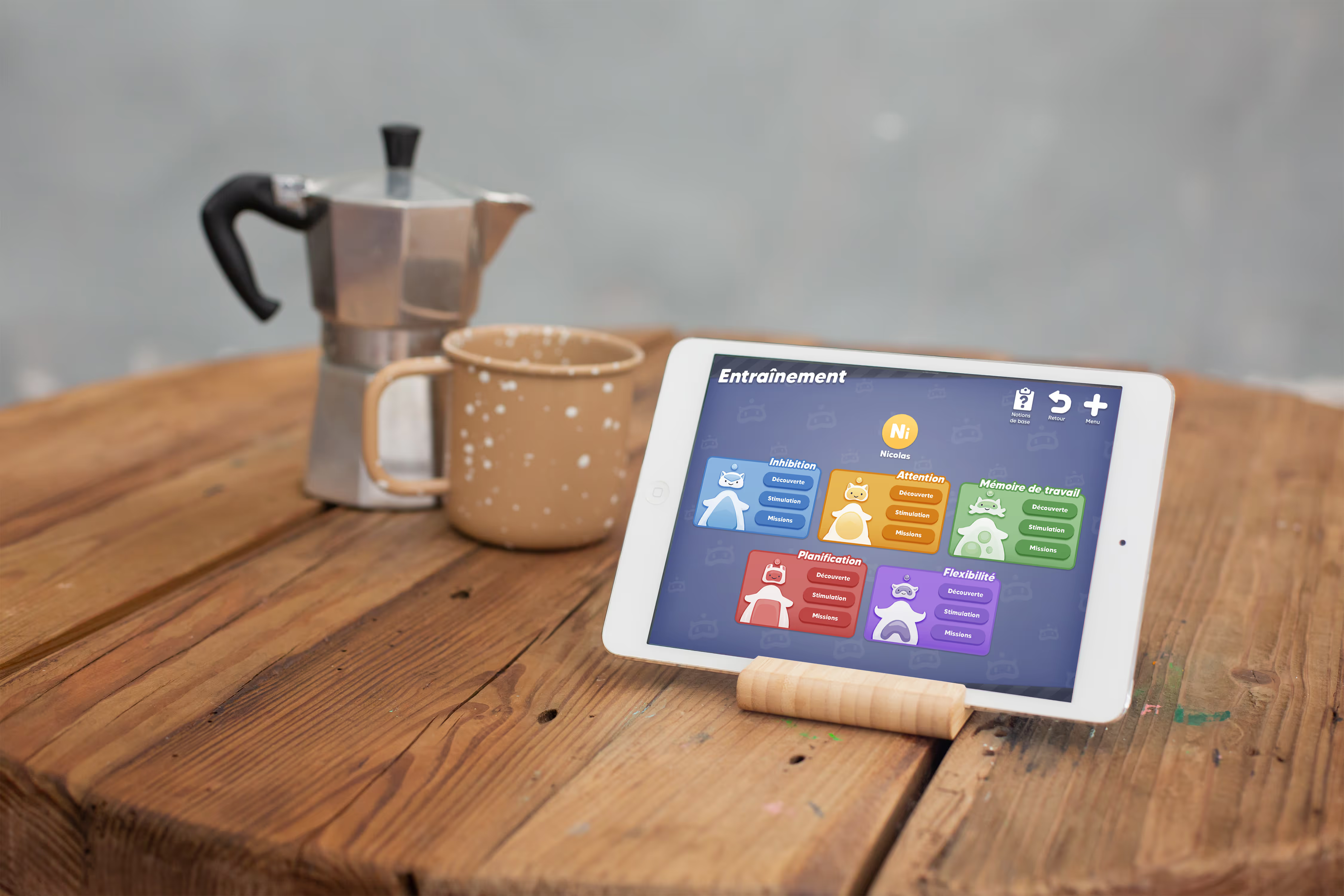
- Targeted exercises, designed to stimulate fragile or deficient functions and underlying processes, particularly Executive Functions
- Games and fun activities to stimulate weak or deficient skills using motivating and environmentally friendly materials for the child
How to prepare my child for a visit to the speech therapist
Speech therapy explained to children, by children!
What is a speech therapist?
A speech therapist is a specialist in language, communication, voice and speech ! They help children (and adults too) to speak better, understand better, read better and write better.
What happens during a speech therapy session?
- Let's get to know each other!
👋 The speech therapist asks you and your parents lots of questions to get to know you better, understand what brings you here and what you would like to see change. - We've got some tests for you!
🧠 Don't worry, you won't get a grade! And there are no good or bad results! These assessment tests are designed to help us better understand your strengths and identify the challenges you need to overcome. They also determine if your difficulties fall within the scope of speech therapy and if regular follow-up is appropriate. Sometimes, it's helpful to consult with other professionals (ophthalmologist, ENT specialist, neuropsychologist, occupational therapist, etc.). Everyone will work together to find the right solutions for you.
⚡ Every brain is unique. The neuropsychologist will identify what feels easy for you and what feels more difficult. - We sometimes even train by playing
🎲 Each activity offered allows you to learn and understand new skills or strategies useful for meeting your challenges. - You'll leave with some tips!
✨ At the end of the session, you might have some small exercises to do again at home, or advice to apply at school to continue to progress between sessions.
Where does a speech therapist work?
Speech therapists (or logopedists) can work in private practice, in hospitals, at home, and (more rarely) in schools.
Which Babaoos will you discover with the speech therapist? What games will you play?
At the speech therapist's office, you will discover 5 Babaoos: the 5 super-allies of your Brain!
- Inhi is the expert in controlling actions and thoughts. Inhi will teach you to pause and think before you act!
- Atteni is the guardian of your Attention. With Atteni, you’ll learn how to focus on the right thing, at the right moment, for as long as it takes.
- Memtra is your ally whenever there's a lot of information involved. Thanks to Memtra, you'll learn to manipulate words, images… without losing them along the way!
- Flexi is the most zen of the Babaoos. If you lose your composure when the instructions change or your first idea doesn't work, don't panic! Flexi will teach you how to adapt to find another solution.
- Plano is always there to help you solve problems. Plano will teach you how to organize your work, step by step, and how to control each step. He's undoubtedly the most organized of the Babaoos!
With each Babaoo, discover and practice through play to develop skills that will help you feel more comfortable at school, succeed, and build confidence.
Day in the life of a speech therapist
Behind the scenes of speech therapy.
The challenges of being a speech therapist
The speech therapist is the superhero of language and communication !
Thanks to their skills, they help children speak more clearly and informatively , better understand what they read or hear , and gain confidence in expressing themselves .
They are superheroes because they face numerous challenges every day:
- 🎯 Adapting to each child : every journey is different, we need to find the most effective approach for each one.
- 🎮 Maintaining motivation : some children have lost confidence in themselves, others get discouraged easily. The sessions need to be both useful… and engaging!
- 🔄 Transfer : a child may make progress during a session, but how can we ensure that it continues after the sessions, at school and at home?
Executive Functions: why work on them in speech therapy?
- 💡 Inhibitory control: why strengthen it in speech therapy? When a child acts too quickly, they risk making errors in understanding or execution. By developing their inhibitory control, they learn to better regulate their thoughts and actions. They thus become more capable of taking time to reflect before acting, which improves their understanding of instructions and their application in school and daily tasks.
- 💡 Attention: why improve it in speech therapy? A child who struggles to concentrate has difficulty completing a task or organizing their actions. Working on attention allows them to better focus on essential information and complete their activities more efficiently and in a structured way.
- 💡 Working memory: why stimulate it in speech therapy? Working memory plays a key role in real-time information processing: it allows us, for example, to remember instructions or the steps of an exercise. By strengthening it, children gain autonomy and precision in their learning and everyday tasks.
- 💡 Cognitive flexibility: why develop it in speech therapy? Adapting to changes or modifying one's approach when a solution doesn't work are essential skills. By working on their cognitive flexibility, children learn to switch more easily from one task to another and to consider different strategies, which strengthens their autonomy and self-confidence.
- 💡 Planning and organization: why work on them in speech therapy? Planning and structuring one's actions are fundamental skills for completing a task from beginning to end. Some children have difficulty anticipating steps or organizing their work. Targeted support helps them better structure their activities, whether schoolwork or everyday tasks.
Babaoo: the app that helps speech therapists work on Executive Functions
A tool developed with cognitive neuroscience experts.
Babaoo supports you
Babaoo is the fun and scientifically sound app that stimulates executive functions and develops metacognition in both neurodivergent and neurotypical children. It offers a turnkey learning path to mastering each executive function through:
- Metacognitive content that can be integrated into short sessions.
- Highly targeted mini-games to raise awareness, automate and contextualize all the skills that allow children to better control their bodies to adjust their movements.
- Missions to be carried out in real life, to support the transfer, between and after the sessions.
Features that speech therapists will find useful
Babaoo offers several modes that will interest you during the session and between sessions with the child:
🎯 Training Mode
- Mini-games to develop each Executive Function progressively and in a way that is adapted to the specific needs of children receiving speech therapy.
- Progressive levels of difficulty that allow children to progress at their own pace and achieve success.
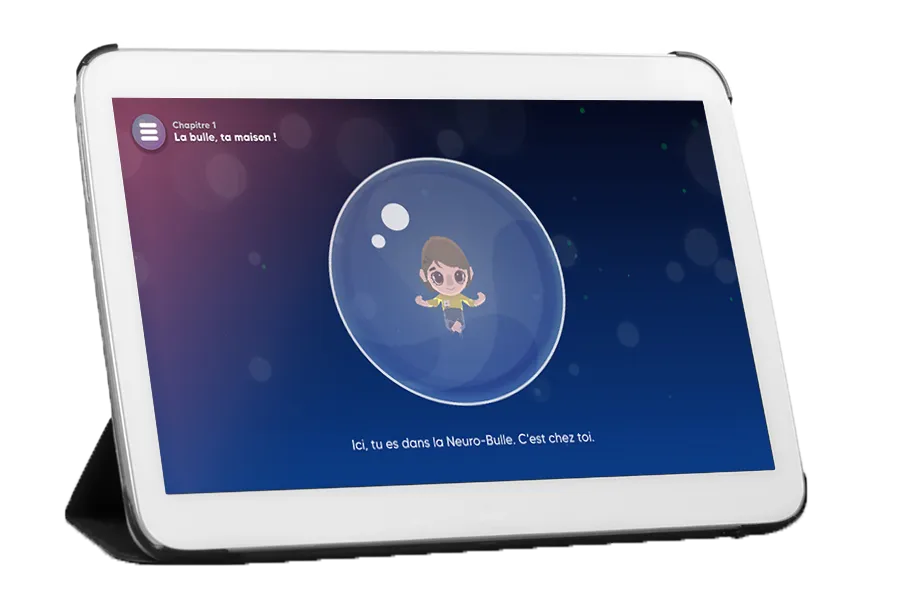
🧠 Adventure Mode
- An immersive and narrative universe that allows children to continue working on their cognitive skills at home, without feeling like they are “doing exercises”.
- An approach that promotes metacognition : the child understands how their brain works and learns to use their own strategies to progress.
🚀 Missions
- Concrete challenges to be carried out outside of the application , to promote the transfer of learning into daily life and to allow parents and teachers to be involved in the process.
- An opportunity to reinforce the strategies worked on in session and to promote the child's autonomy.
📊 A multidisciplinary tool
The neuropsychologist, the occupational therapist and the teacher can also rely on Babaoo, facilitating a coherent multidisciplinary care approach .
Go further.
➡️ To learn more about the profession of speech therapist and their role with children, check out our article on the subject!
Help your child master Attention
Short, guided sessions to develop Attention and Self-control, at their own pace.