

.svg)



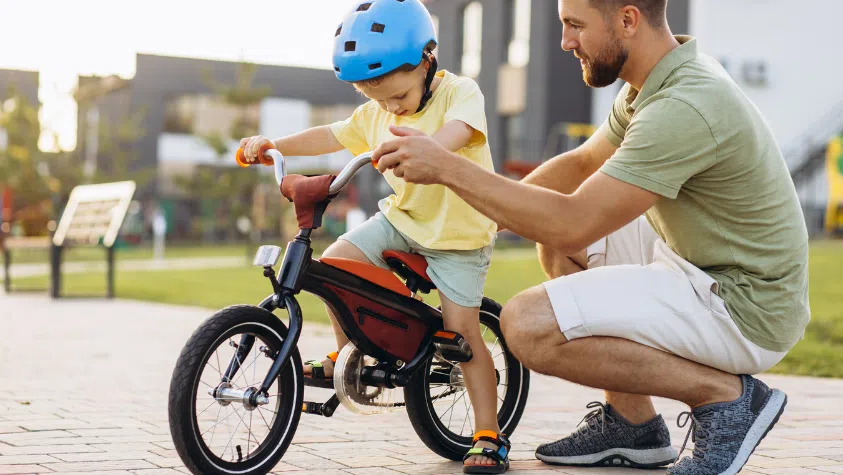
When a baby is born, it does not need to learn to breathe or suckle its mother’s breast. They do it on their own, instinctively. Without anyone having taught him, or shown him. But very soon, to get out of his infant state and evolve, he’s going to have to learn to do a whole host of things: talk, walk, tie his shoelaces, count… quite a programme! 🤯
Thankfully, human beings are well built: they have a thirst for learning. From the baby who can’t wait to walk, to the senior citizen who dreams of learning Italian, there are so many skills to acquire! But of course, acquiring a new skill doesn’t happen overnight.
While learning is a long road full of challenges and opportunities, it is also strewn with pitfalls… Yes, a child learning to walk is more likely to be on his backside than on his feet! But one fine day, he suddenly finds himself gambolling alone in the garden. How did he manage this trick? What stages did he go through, and why is it important to understand these key phases? Babaoo Mag has the facts for you!
Understanding the learning process
Acquiring a new skill is magic! ✨ And this magic happens in the brain. Between his first attempt and the moment when he walks without having to think any more, the child has gone through different levels of self-awareness: “The four stages of learning”.
For a parent, teacher or childcare professional, it’s vital to be familiar with this process. Understanding these different stages and being able to identify them helps children to go through them gradually, without burning them out. So they can acquire – and consolidate – new skills. In short, to develop their potential!
✏ Note: Children have a particularly marked thirst for learning. Every time they develop a new ability (physical or mental), they feel like they’ve got a superpower. So they come back for more! 💪
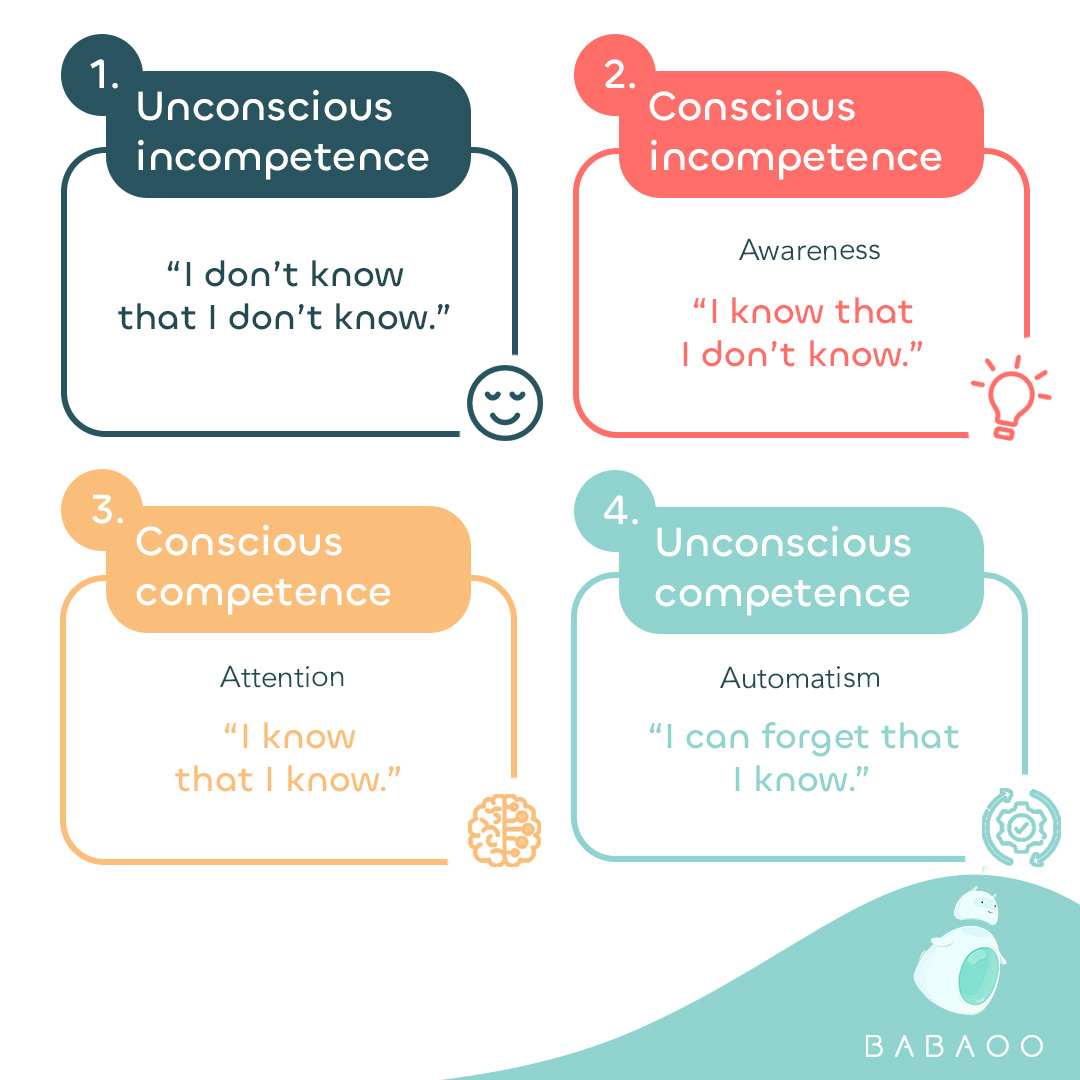
The four stages of learning
During any learning process (reading, playing the piano, driving…), we all go through different psychological states, which we liken to stages.
A bit of history? 🤓 The process was modelled around fifty years ago. Originally called “The four steps before learning a skill” by Martin M. Broadwell, it was used in 1970 by Noël Burch, an employee of Gordon Training International. Let’s look at it in detail…
1. Unconscious incompetence
“I don’t know that I don’t know.”
This first stage is that of ignorance. It is, for example, the child who watches his daddy drive and thinks “It’s easy, I could do it too”. He doesn’t know that he can’t do it (he hasn’t learnt to drive). Or the baby who sees others walking and doesn’t know that one day he’ll be walking too, because the idea hasn’t crossed his mind. For different reasons, they are both incompetent, but they don’t realise it. But if you take the baby’s little hands and help him up, or if you hand over the steering wheel to the child, they will know that they don’t know. This awareness marks the transition to the next stage. ⤵
2. Conscious incompetence
“I know that I don’t know.”
This is the time of the first trials. You take the plunge, you try to learn, you experiment… and at first, inevitably, you fail. It’s an uncomfortable stage, and one that can be resented: “I’m no good at it”, “I’ll never be able to do it”…
At this stage, the role of the parent or carer is crucial. When faced with a new skill, children (like adults) need to be stimulated and encouraged if they are to progress, and above all, if they are not to be discouraged. Patience and perseverance. Unless you’re unbelievably gifted, no one is capable of playing Beethoven’s Fifth Symphony after three piano lessons! 🎼
✏ Note: So yes, experiencing failure is never pleasant. But when you think about it, making a mistake is also an opportunity to understand what went wrong so you can move forward! And what if our everyday “Oops! We’ll tell you more about this pedagogy of mistakes in a forthcoming article.
3. Conscious competence
“I’m evolving and I know it shows.”
This third stage is the first visible results (so cool to ride a bike without the little wheels!). All those efforts finally rewarded, well done! 👏 But there’s still a long way to go. Because at this stage, the new skill is not yet fully assimilated.
To succeed, you still need to concentrate and think about what you’re doing. And our “little inner voice” is working at full throttle! It’s only after much, much practice that the final stage seems to take shape!
4. The unconscious skill
“Now I can even forget that I know how to do it.”
This is it! By dint of practising the new skill (regularly), you manage to perform it without thinking about it any more. The learning is acquired, it’s become automatic. And it’s magical to see that walking has become the most natural thing ever for the child who, just a few weeks earlier, was taking his first steps.
How do you know when a skill has become automatic It’s simple: when it can be performed, without thought or effort, at the same time as another task. That’s right, now your kiddo can tie his shoelaces while reciting the alphabet! 💡
Unbeknownst to him – and his parents – the child has gone from unconscious incompetent to unconscious competent. It’s the magic of learning! 💫
➡️ Find out how Babaoo uses the 4 pillars of learning as defined by Stanislas Dehaene, to teach children how to learn.
✏ Note: When a skill has become automatic, the work is not finished. For it to remain acquired, you have to practise, practise and practise some more! It’s a bit like English… you know, that language you understand but should practise more to speak it better? 😅
The Babaoo recap
How did this thing you were incapable of doing become automatic? Is it magic? Yes, it’s the magic of learning! But it doesn’t happen with a snap of the fingers. We are all – and children in particular – eager to learn how to do something new. But many of us get discouraged along the way.
The key is to understand the four stages of learning so that you can get through them without giving up, and to be aware that you have to practise to progress! Each stage completed is a spark in the fireworks of your child’s development. So let’s encourage our little magicians to blossom, experiment and transfer their skills from one experience to the next. 🚀